I had my first of four thoracic outlet decompression surgeries on October 7, and so far my recovery has been so smooth, I keep waiting for the catch. Negative medical experiences tend to be over-represented online, as people with good experiences aren’t seeking a space for advice, commiseration, or validation, so I thought I’d document my relatively uneventful pre- and post-op experiences, in case anyone out there finds it useful.
The Road to Diagnosis and Pre-Op Prep
Like most of us with complex, under-diagnosed syndromes, it took an unnecessarily long time for me to be diagnosed with thoracic outlet syndrome (TOS). My rheumatologist had floated the idea of TOS once, sent me for one x-ray, and decided from that one image that I didn’t have it. It took approaching death’s door and having a cardiologist—Dr. Susan Polizzi, who has treated me for POTS and who I would die for, which is maybe fitting as she became instrumental in saving my life—willing to refer me to an interventional vascular neurologist, just because I was out of ways to prove or disprove my years-long working theory that underlying craniocervical instability (CCI) was one of the root causes of my symptoms, on the off-chance that a CTV of the head and neck would capture something useful.
And I got additionally lucky: This neurologist—Dr. Karthikeyan Arcot—is Tamil and didn’t need me to explain my Eelam Tamil heritage. We established a mutual biocultural understanding of pain instantly. (Something is wrong, he said after 45 minutes of the intake. Something is very, very wrong. You’re in your early forties. You’re extremely sick. And: You’re highly educated from an academic family; you seem high-functioning at a glance; you’re not trying to fool these doctors; they just let themselves be fooled.)
He sent me for a CTV of the head and neck, an MRV of the pelvis, a thoracic MRI, a lumbar puncture, and various other due-diligence tests. As a result, I was conclusively diagnosed me with: critically severe May-Thurner syndrome (MTS) with near-total occlusion of the left iliac vein; bilateral venous thoracic outlet syndrome (vTOS) and neurogenic thoracic outlet syndrome (nTOS); and internal jugular vein (IJV) compression so severe my jugular veins aren’t apparent on imaging and it’s caused collateral veins in my brain to become dangerously swollen, as my frequent stroke-like symptoms attest to.
While waiting for Aetna’s final determination on the IJV decompression surgery I desperately need (four denials and escalating appeals and counting, as I continue to decline in debilitating, life-threatening ways), I was approved for bilateral TOS decompression surgery with follow-up venoplasties with Dr. Naiem Nassiri, the vascular surgeon Dr. Arcot referred me to, and—to try to buy myself some time—decided to forge ahead with them.
Each side requires two planned procedures (though as with all exploratory surgeries, plans may change once I’m in the OR): a rib-sparing scalenectomy and pec minor release, coupled with neurolysis, perivenolysis, adhesiolysis, and other necessary decompression and debulking. WIthin two weeks of that surgery, I’d undergo a venoplasty to inflate my damaged veins to appropriate size.
I was told this would let me live past my estimated death date in November—when I should be turning 43—so, given Aetna’s dedication to denying the IJV decompression surgery I need, it’s the only real hope I have right now. Still, the fact that all these surgeries are spaced maybe 2-3 weeks apart—and all that after having had four diagnostic venograms and an iliac stent placement in the span of 3 weeks in August—has left me exhausted.
The Surgery Itself
I had my first TOS decompression surgery done on 10/7 by Dr. Naiem Nassiri at Norwalk Hospital. We started with the left upper extremity, as my diagnostic venograms showed it was marginally worse than the right. It was a supraclavicular surgery involving one 2-inch incision and one 3-inch incision.
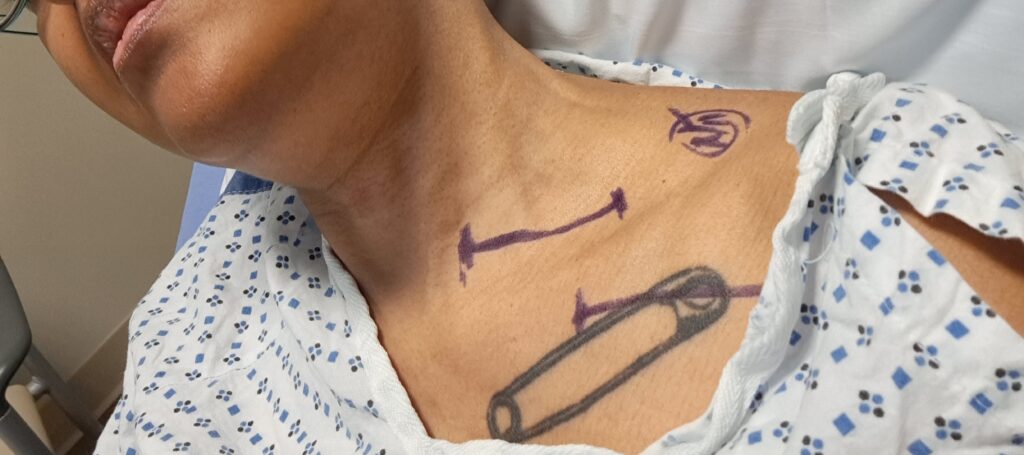
My intended procedure was a rib-sparing surgery involving a scalenectomy (the removal of one or more scalene muscles) and a pec minor release (the detachment of that tendon from the chest muscle), along with any other necessary debulking and decompression. What ended up happening was the removal of the anterior scalene, release of the pec minor tendon, release of the subclavius muscle, and release of the clavicular head of the sternocleidomastoid muscle. In addition, Dr. Nassiri performed extensive perivenolysis around the subclavian vein (due to the vast network of collateral veins that had formed in an attempt to compensate for the severe stenosis), neurolysis around the brachial plexus, and lysis of adhesions and fibrotic bands that had formed throughout the neck, collarbone, chest, shoulder, and arm. This opened up enough space that my veins began moving with respiration (and my rib could definitively be spared).
The time estimates I was given ended up being pretty accurate: I arrived by 12:40, was fully prepped by 1:40, was in the OR for surgery at 2:00, sent to PACU around 4:00, and fully conscious around 6:00. The surgery went smoothly. The only real snafu I encountered was that the IV pigtail was initially poorly placed in my inner elbow, resulting in an uncomfortable redo by the anesthesiologist in the back of my hand in the OR. Once mobile x-ray cleared me as negative for pneumothorax, I was discharged.
From patient anecdotes on Reddit and Facebook, I had a general sense of what to expect of recovery—though, as noted above, this admittedly skewed towards painful, prolonged, problematic recoveries even in the first couple of weeks—which was useful since my discharge instructions left a lot to be desired. The instructions about removing the top dressings and Steri Strips were confusing; no one spoke to me about physical therapy (and in fact, it was implied I wouldn’t need it, despite having a flavor of hypermobility and having layers of tendon and muscle avulsed); and I had to prompt the clinical team for instructions regarding diet for the first 24 hours, weight restrictions for the first 2 weeks, and a return-to-work (even remote office work) timeline.
I didn’t get to talk to the surgeon afterwards, but my sister did briefly, and he told her my subclavian and axillary veins were entrapped and compressed (as expected) but the subclavian vein was so occluded, it was no wonder I’d had so many vTOS symptoms for so long.
Two Weeks of Post-Op Recovery
My pain was well-managed when I left the hospital, and I was sent home with ketorolac and methocarbamol and was told to stagger it with 925 mg of Tylenol. I was also sent home with Tramadol, a prescription I’m familiar with due to chronic pain and the one that made me most concerned about how unmanageable my pain would become (since, in my experience anyway, Tramadol isn’t commonly prescribed). Turns out, despite all the horror stories online, Dr. Nassiri was right in my case when he casually suggested that a life measured in doses of chronic pain has created in me a person who would be ready for this level of post-op pain.
To contextualize my recovery experience so far: I’m very used to pain. I’ve lived with chronic pain and fatigue for 20 years, possibly longer. I lived 9 months with a perforated appendix. My good days on the normative pain scale are a 6, and my typical days are around a 7-8. While within those ranges exist different flavors of pain that are more or less tolerable, it’s extremely rare that acute or chronic pain stops me in my tracks.
By the time I got home, night had descended. My arm felt extremely heavy but not completely useless. Moving my head, neck, and jaw was difficult, and I grimaced over every pothole in Manhattan, but the pain was otherwise negligible. At first (spoiler: this did not last), I noticed that the stroke-level occipital throbbing had lessened a bit, even if it was still there (and no less frightening for its presence). I didn’t use my arm for much of anything for the first 24 hours, and I was automatically careful with the position of my head, neck, shoulder, and arm (sharp twinges or the tautness of my wound dressings reminded me quickly if I forgot).
I had a popsicle at the hospital and had stocked up on liquid meals, like protein shakes, drinkable yogurt, rice pudding, bone broth, and soup but was told to limit myself to crackers for the first night. I didn’t have much of an appetite for Days 0-2, which was for the best in some ways because moving my mouth and chewing pulled on the bandages tugged on the fresh wounds. There was a lot of swelling under the bandages and therefore a lot of tightness and pulling in these first couple of days, but since I couldn’t stop my dual anti-platelet therapy (aka Plavix and ASA) due to recent stenting, I knew why the compression had to be so strong.
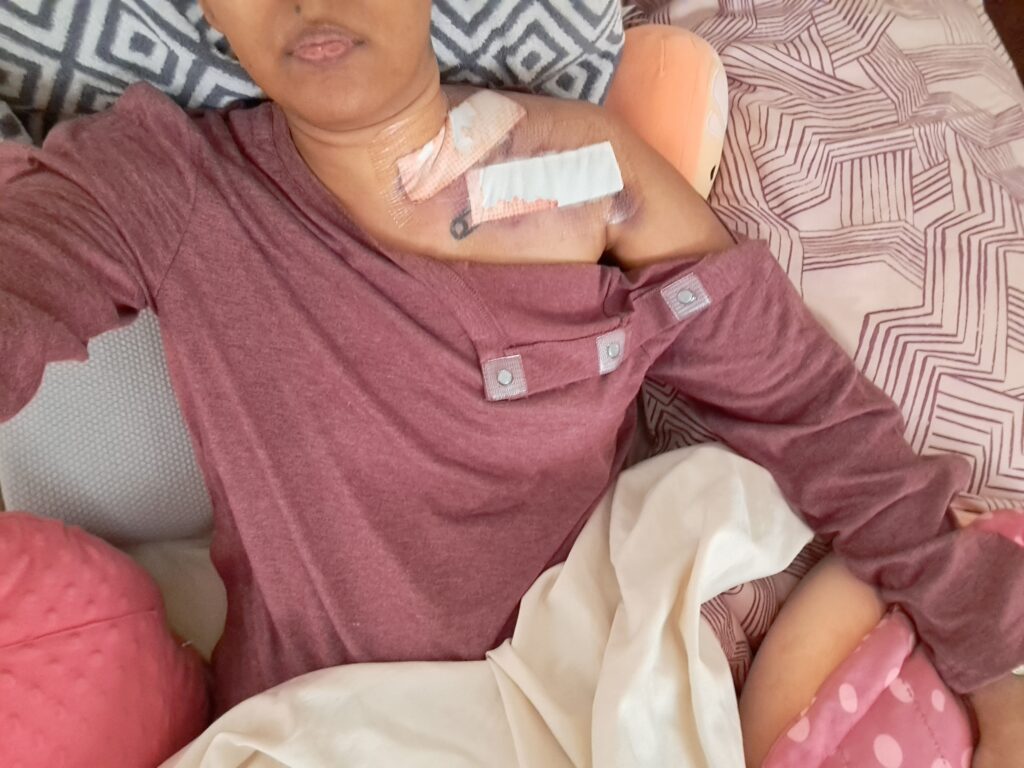
I had to wait 24 hours to shower, but my sister wiped me down with these Medline ReadyBath washcloths, especially around the neck, chest, left arm (avoiding the bandages, of course), nape, and back of the head, to clean up the worst of the blood and Betadine stains. I slept on this reclining cushion a Redditor had recommended, with my left arm propped on this sea turtle Squishmallow (which I already owned but ended up being the perfect height) to minimize pain from engaging the neck muscles when getting up and down from a horizontal position.
I had difficulty sleeping that first night due to discomfort and intractable insomnia caused by the untreated jugular vein compression, but while I woke up in pain—a dull, relentless, intractable ache through the back of my upper arm and shoulder and across my scapula, like the repeated strikes of a baseball bat—I personally didn’t find it intolerable. Which is to say it wasn’t worse than a fibromyalgia flare. That said, I relied on round-the-clock NSAIDs to keep the pain manageable and experienced unbearable acute spikes of pain, like every time I was coughing up phlegm (and it took a few days to fully clear my lungs).
The top dressing came off the evening of Day 1. I was taped up with Steri-Strips underneath. It looked like the wound’s edges hadn’t been fully pulled together under the strips to begin with, or that swollen tissues had pulled them open in spite of the strips. I was told I could get the Steri-Strips wet (not soaked) and clean them by letting soapy water run over them, and that they would fall off in a week or so, but since adhesive tends to cling to my skin, I just assumed I’d be removing them manually at some point. After my shower, I couldn’t tell if I was spotting blood from those open spots (which wouldn’t surprise me since I’m on blood thinners) or if it was from the copious amounts of dried blood under the bandages.
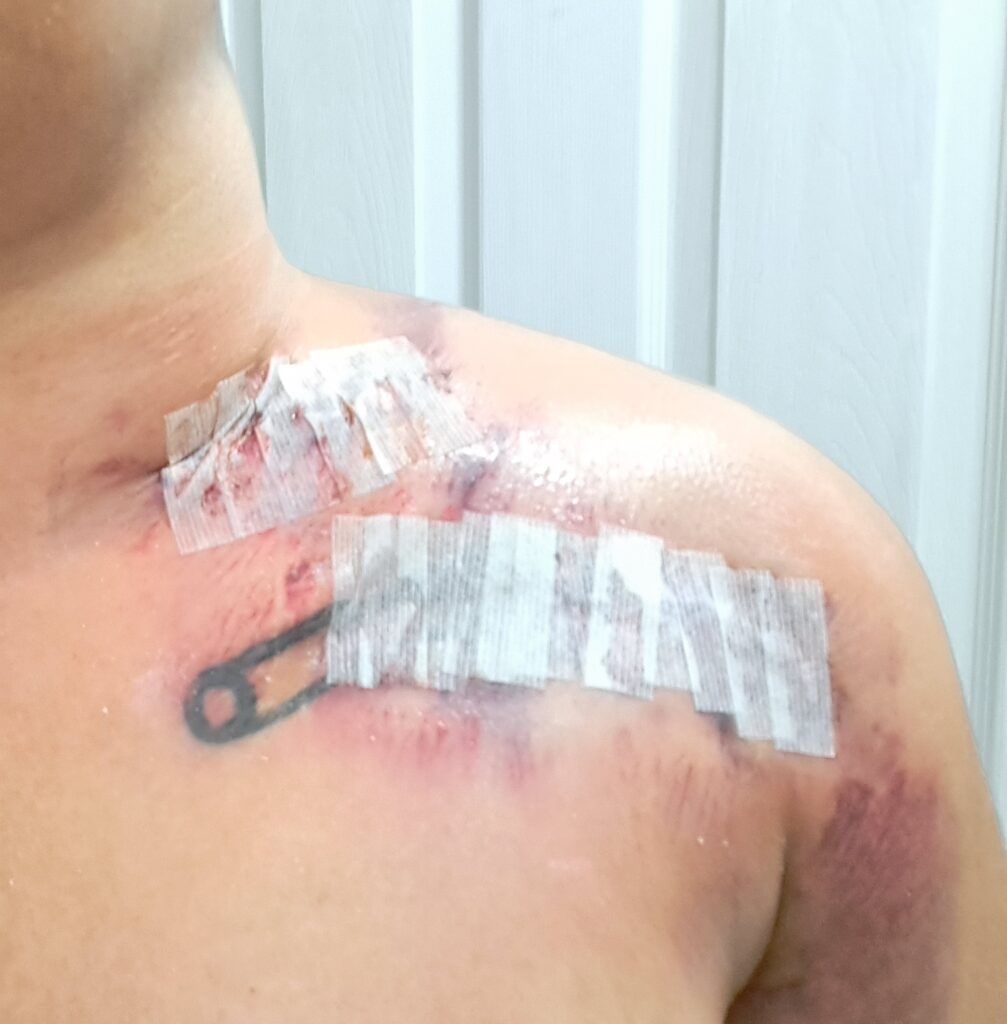
By Day 2, the swollen lump on the left side of my neck had gone down quite a bit, but bruising had increased along the back and side of my arm were bruised, and there was considerable swelling in my left breast. By Days 3-5, the pain had peaked. Anecdotally, Days 3-5 are considered to be the lowest point of any post-surgical recovery. By this point, any residual effects of anesthesia have worn off; patients are usually running low or out of the strong painkillers; and bodily inflammation is at its highest. I was more, not less, exhausted as the days wore on. While my brain continued to wake me up at 6:30am no matter when I fell asleep, I found myself falling asleep at random at least once a day. My arm was so swollen, it was almost impossible to bend it at the elbow. That relentless ache still wasn’t intolerable, but was maddeningly distracting. Most of the pain was concentrated in my armpit, upper arm, elbow, upper forearm, and left breast, which has become (hilariously) noticeably bigger and differently shaped than the right.
I already relied on ice packs for my head to try to address the stroke-like symptoms I was experiencing, but I was applying ColPac ice packs (my ice pack of choice, as it’s a brand commonly used at physical therapy clinics, is easily moldable, and retains cold longer than most ice packs, and exudes less condensation moisture than most ice packs) to my arm, breast, and incisions as frequently as I could without giving myself frostbite.
By Days 6-9, the swelling in my arm had traveled all the way to my wrist. I started to worry I was developing chronic lymphedema. I bought a light compression sleeve and wore it a few times, but noticed that it just pushed the swelling higher up, into my neck and face. There wasn’t much else I could do to address the swelling, though, because I wasn’t able to elevate it above my heart without causing pain. I attempted to reduce it through gentle mobilization of my arm and light lymphatic drainage massage, but mostly, I had to wait it out. By Day 9, the swelling in my arm had receded on its own, and the bruising in my arm and breast had disappeared.
Additionally, maybe starting on Day 6, I found I was able to somewhat painlessly engage in light, mindless computer work (like file sorting or tallying asynchronous participation in my online courses), but I ended up doing a lot of typing on Day 8, because Aetna denied my brain and spine surgeon’s written appeal, telling his office to submit a level-two written appeal, while I could submit a member’s complaint and appeal. I drafted the whole package in a matter of hours; it ramped up my pain considerably in my neck and arm, but I was at least able to sleep it off.
My cat had been curious about my left shoulder since the surgery but became persistently nosy by Day 9, which is incidentally when I noticed an odd smell coming from the bandages. On Day 10, since the edges of several of the Steri-Strips were beginning to curl anyway, I made the executive decision to manually remove the strips, exposing a 2-inch and 3-inch incision:
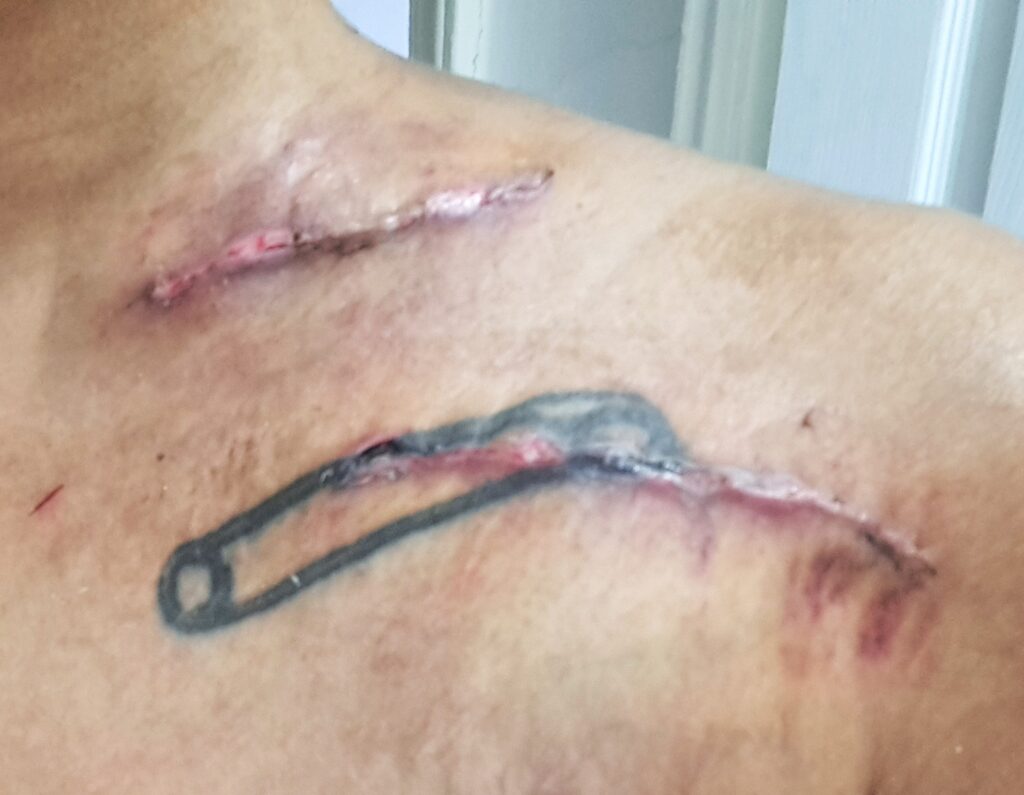
Cutting through the safety pin tattoo paralleling my left collarbone was unavoidable, but now that the bandages are off, I’m kind of into how it looks the safety pin is holding the wound together.
The process of removing the bandages left me a little lightheaded because of how I had to tilt my head, but it wasn’t intolerable. The Steri-Strips did peel off new skin in two places, resulting in light bleeding, but the incisions were otherwise closed and healing well. I’d guessed correctly: the odor was from the trapped dried blood. The incisions spotted blood for the next couple of days, so I covered them lightly with non-adherent dressing pads.
I wished they’d been able to clean off more of the blood before dressing the wounds, so I could have waited longer before removing the Steri-Strips, but I was glad the wounds weren’t infected. However, my skin was really irritated from wound dressings and medical tape, so I opted for off-shoulder clothes to let the wounds and my skin breathe without staining anything. I taped gauze over them at night to prevent accidental injury, bloodstains, and my cat’s insistence on ministering to me.
I think Day 11 was probably the most dangerous turning point for me, because while I still had pain, it wasn’t as restrictive as before—meaning that I kept accidentally resorting to instinctive neck and arm movements. Coughing, laughing, and accidentally guarding with my neck muscles still ranged between 8.5-10 on the pain scale. Overcompensating with the back of my neck feels worse than before, and sometimes more quickly causes the onset of the occipital throbbing, nausea, headache, blurry vision, and other stroke-like symptoms.
I got my medical records around this time, detailing the removal of the anterior scalene, the release of the pec minor tendon and sternocleidomastoid and subclavius muscles, and extensive perivenolysis, neurolysis, and adhesiolysis. The surgical documentation included gems like these:
- “Extensive adhesive bands and inflammatory and fibrotic changes were noted along the pectoralis major preventing me from creating a avascular plane in between the bands of the pectoralis major requiring electrocautery to create the space.”
- “The pectoralis minor muscle was not readily visible. It was noted to be hypertrophied… Of note extensive venous tributaries and collaterals were noted throughout the region secondary to the severe stenosis of the subclavian vein as well as the laterally axillary vein that was compressed by the pectoralis minor.
- “[There were] underlying adhesive bands and inflammatory tissues representing chronic inflammation around the brachial plexus cords. Blunt and sharp dissection was carried out extensively lysing these adhesive bands around the brachial plexus cords and mobilizing these nerves to now reside freely in that space.”
A productive two-hour procedure, all in all. No wonder everything is achy and numb in there, and no wonder my shoulder has felt more unstable than usual as everything heals.
Days 12 and 13 marked my first full days of light remote work and teaching, which consisted of attending one 1-hour committee meeting and teaching one 90 minute class. Honestly, both felt like stretching my capacities to the limit. I ended both sessions with throbbing in my neck, pain in my upper arm, and stinging in my incisions.
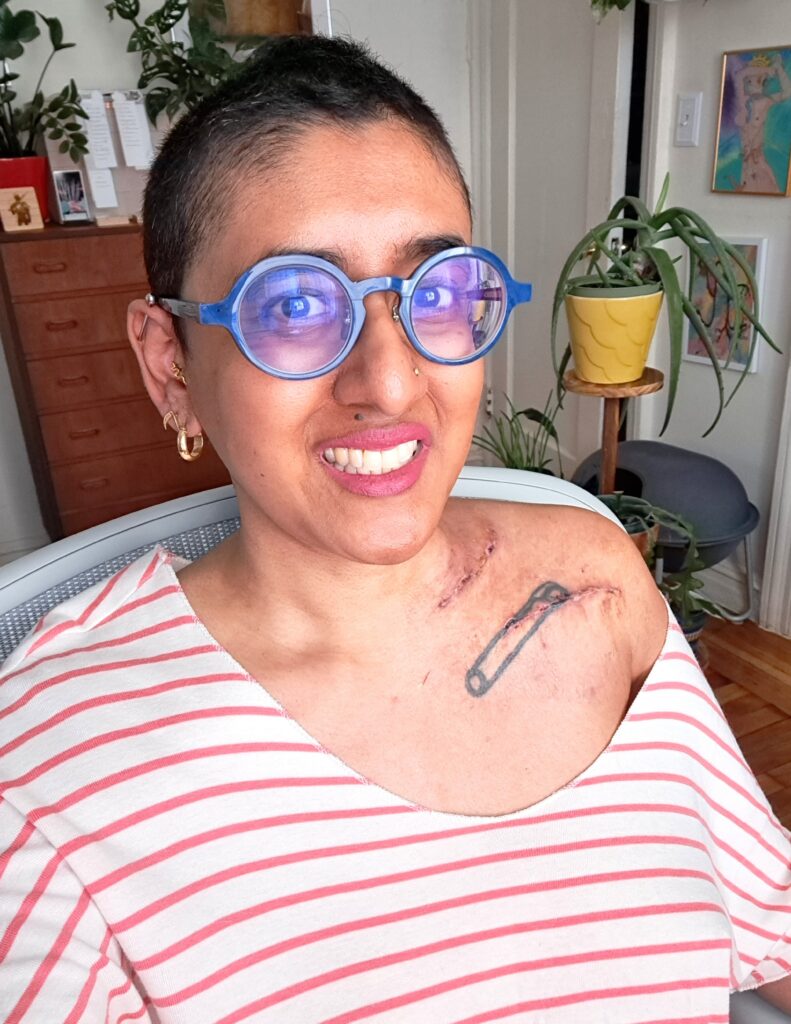
I was glad I had an off-shoulder shirt on hand, because getting dressed is still difficult, and as superficial nerves were starting to revive around this time, the incisions had started stinging every time they were brushed by anything—whether gauze or clothing. (Wearing a bra, of course, has become impossible.) I felt a little self-conscious about going to faculty meetings and teaching a class sans bra and with my fresh scars out, but my friends assured me I looked fine, badass, even.
Can’t wait to see what I look like when I get the matching set of scars on the right side in November, when I go back for the right-sided scalenectomy scheduled six days after the birthday I’m not supposed to live long enough to celebrate.
Reflections at the Two-Week Mark
My recovery process has been what I would call relatively easy, I can also easily see how someone who hasn’t been rewired by chronic pain would call it unrelenting agony.
There are a few things I wish I’d been better prepared for. Dr. Nassiri mentioned that “some swelling was normal,” but had I known that “some swelling” meant my arm was going to look like lymphedema, I would have bought a compression sleeve in advance and tried to start gentle mobilization earlier than I did. If I’d known the incisions would spot blood for a while and remain sensitive to any sort of pressure, I would have preemptively invested in more non-adherent dressings and off-shoulder or strapless tops. I would have started a light physical therapy regimen earlier, even if it was just going for short walks outside. If I’d known I’d be feeling more like myself before the first two weeks were done, I would have bought different groceries. And I wish it had occurred to me to buy dental floss picks and face wipes, because washing my face and flossing my teeth—impossible for the first week—remains tricky.
On Friday, I return for a balloon venoplasty, where a venogram is performed and a balloon-tipped catheter is inserted to inflate the damaged veins to normal size. While damaged veins can’t be fully restored, this will theoretically improve my blood flow, now that there’s room for the veins to remain inflated and to move with respiration. I’m more anxious than usual, since I’ve never had a balloon venoplasty before and therefore don’t know what to expect, and also because I am still recovering from this procedure.
I’ve been typing this in short stints, but typing is becoming painful, so I’ll close by noting that these TOS surgeries might buy me some time by opening channels in the body into which blood can drain, but as Dr. Arcot noted, they don’t address my internal jugular vein compression or swollen collateral veins in the brain, and I remain critically ill. In my last follow-up with him, he did mention the possibility of it becoming an emergency.
I don’t know how I’ve managed to stay alive this long. I feel lucky that these TOS surgeries, at least, were scheduled swiftly. I feel a little more hopeful that I’ll live past my birthday next month. I wish I had a concrete sense of how much time has been restored to me, while the jugular compression issue continues to worsen and Aetna continues to deny.