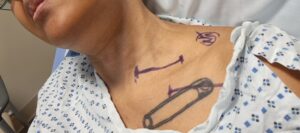
I thought I’d do a brief write-up of my follow-up balloon angioplasty (technically a venoplasty) since I haven’t seen much online about that experience, even on Reddit (except for one Redditor who mentioned that his venoplasty hurt and bruised more than his decompression surgery, which I’m glad I knew about for reasons that will become abundantly clear in this post).
On October 23, two-and-a-half weeks after the left-sided TOS decompression surgery, I went back to Dr. Nassiri’s office for a left balloon venoplasty. This procedure was intended to do two things: inflate compressed veins to somewhat normal patency, and use the veins as a conduit to push surrounding tissues even further away from the vein in an attempt to preserve enough space for the veins to function normally.
My experience of the operation was like the diagnostic venograms in that conscious sedation was used—and unlike those venograms in that I remained fully conscious for the entire procedure. To say that this was painful, stressful, and traumatic would be an understatement. I remember the surgical team asking me periodically how I was feeling and adjusting my IV drip of painkillers accordingly; I remember feeling terrified of accidentally moving in a way that would cause complications; I remember having to uncomfortably turn my head to the right, the blurry white sheet wrapping my arm; I remember the large, dull pain when the catheter was inserted into my upper arm, the black-hole pressure in my chest, shoulder, and arm, the sound of my voice croaking out responses to What does that feel like? or How much pain are you in? I remember fervently wishing I would pass out and being extremely grateful for my experience of chronic pain, which enabled me to hold perfectly still and withstand all of those intensities and sensations.
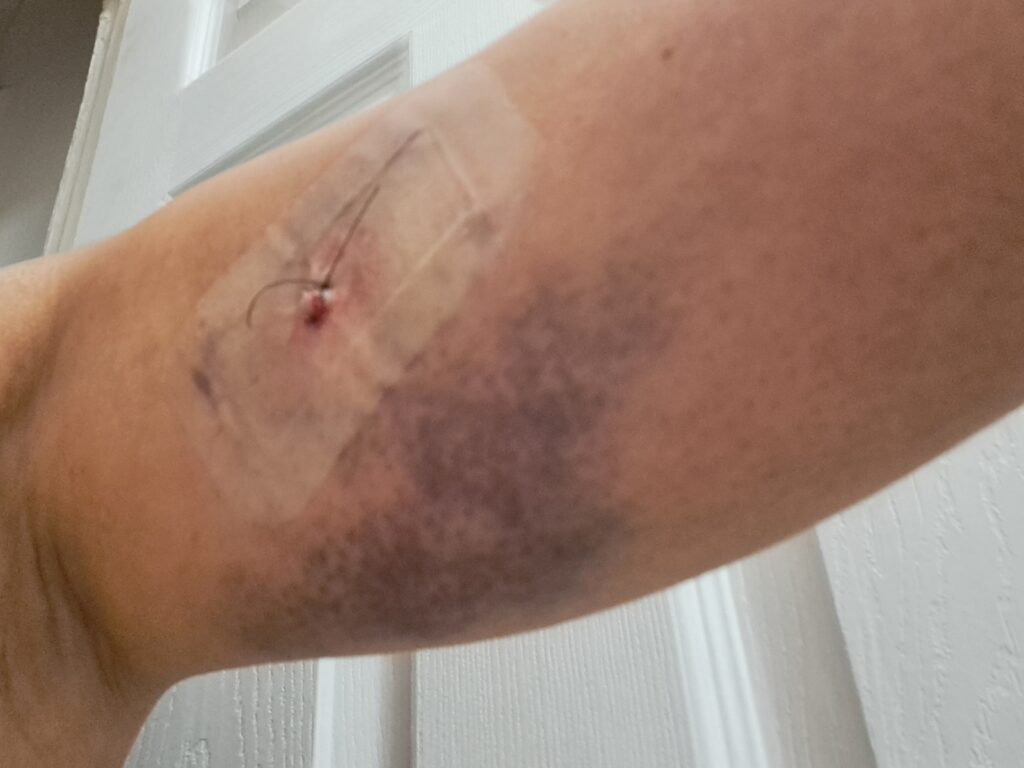
Three weeks out from the procedure, the direct trauma of the experience has largely faded, though I still have a vague sense of it, the way you winter remains on the skin as a faint memory through the spring. Ultimately, I don’t think the venoplasty was more painful than the thoracic outlet syndrome (TOS) decompression surgery, but I had more swelling and bruising than I expected, with pain running from the side of my breast down to my elbow.
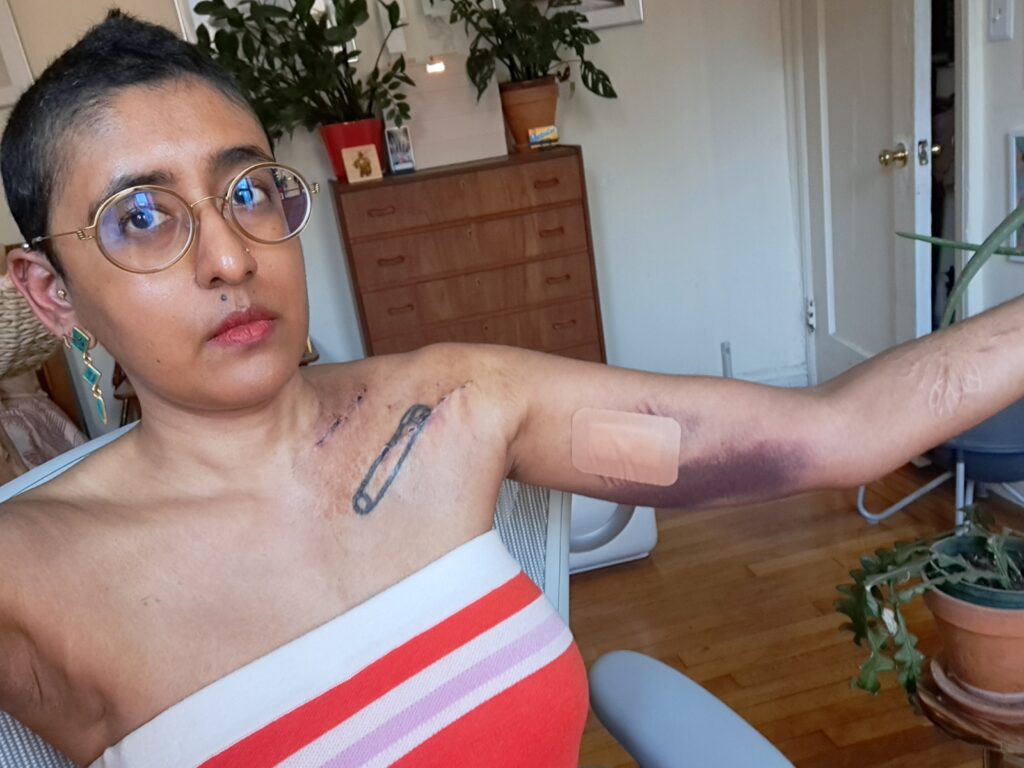
By Day 4, the bruise had turned almost black and spread down my upper arm, and the nerve pain and pressure in my chest—while tolerable—required a steady regimen of the gabapentin I’d been prescribed, which left me feeling both relatively (not completely) pain-free and sporadically exhausted. I spent a lot of time working in reclining positions for neck-related comfort and stabilization reasons only to randomly pass out and wake up an hour later wondering what had happened.
We also had several storms pass through New York, which significantly amplified the nerve pain, so I was also grateful I take pregabalin as one of my mainstay drugs for chronic pain. Between those two medications, I’d say my pain was relatively well-managed apart from the deep muscle and tissue ache in my arm.
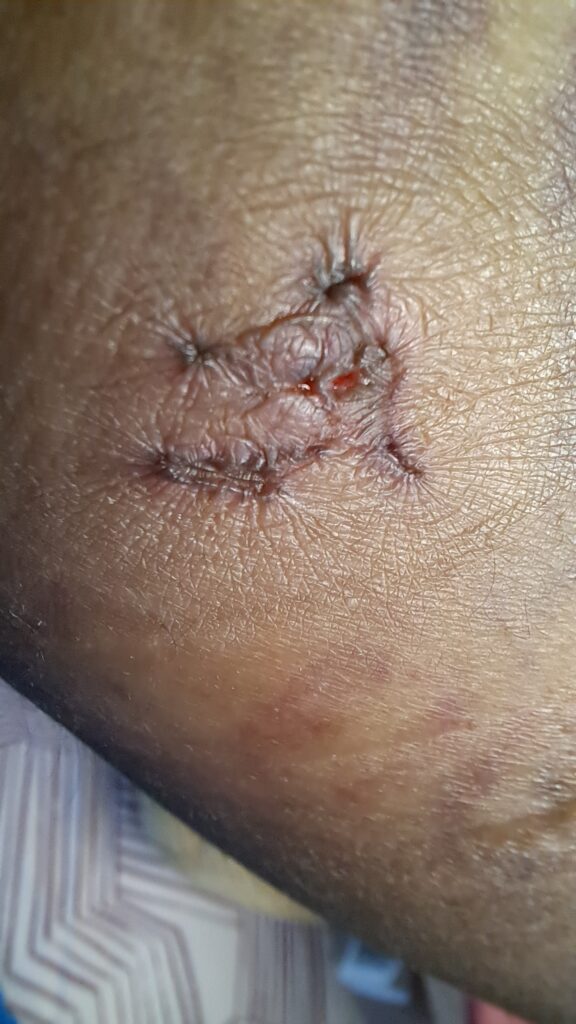
Dr. Nassiri uses purse-string sutures, which look messy under the bandage, are a little complicated (puzzle-like, according to one of the nurses) to extract, and leave strange shapes when they’re finally removed a week later. I still have strange scars and bumps under the skin from the access sites for the diagnostic venograms.
It’s still hard to say what the full benefits of these procedures are, since I’m still healing, have large areas of numbness, and have had to fight my instinct to tense my left shoulder and neck. I struggle with pressure-related motions with my left arm still (opening medicine bottles, washing things, even applying lotion) but can raise it slightly overhead without feeling limited by twinges of pain (though the venoplasty has made moving my arm more difficult). Chewing sometimes brings tears to my eyes still. And fits of laughter, big yawns, and coughing and sneezing still cause painful neck spasms.
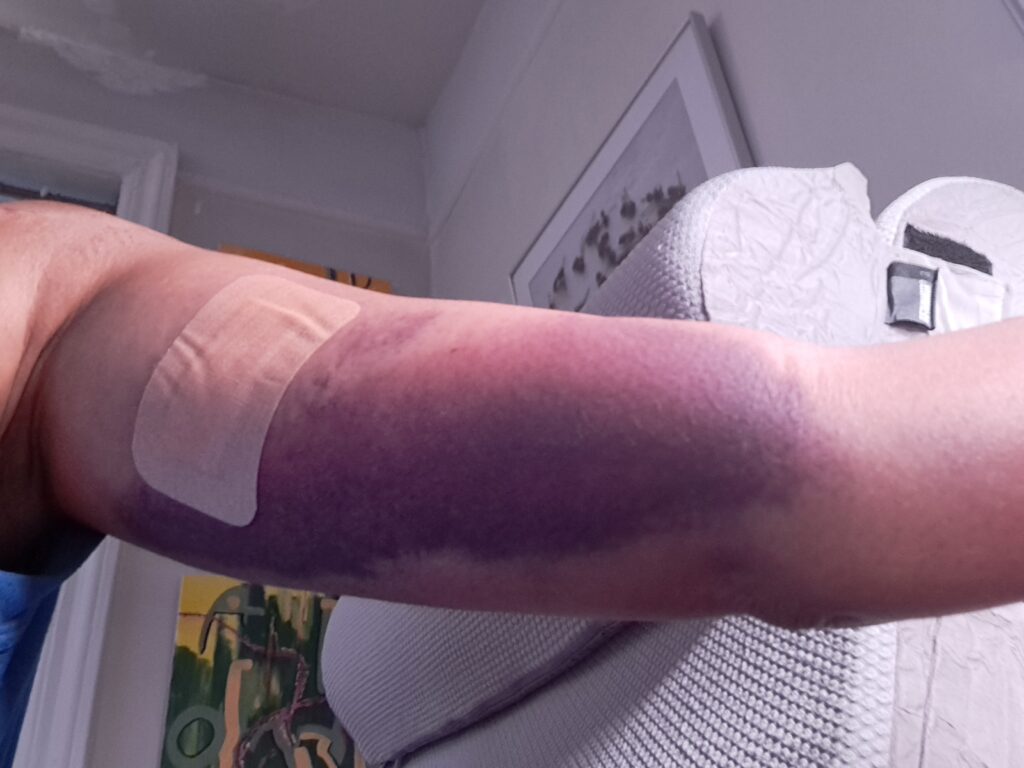
Three weeks later, the bruises still haven’t faded. It’s apparently normal, especially since I’m on dual anti-platelet therapy, but I still hope that they disappear before the right-sided TOS decompression surgery: partly because of my paranoia that any sign of something wrong will delay surgery, but primarily because I’ll lose the use of my right arm for a while after that surgery and will need to rely on my left.
And before my next surgery, I have my pre-op clearance appointment next week, followed swiftly by my 43rd birthday—the one I’m not supposed to live to see. I feel simultaneously optimistic (i.e., I’ll live to see it) and apathetic (i.e., I’m too tired to keep living).
I can’t go on. I must go on. I’ll go on.