I have been existing at the threshold of death for at least the past 3 years. I am frozen with one foot through the door, unable to tell if I’m poised to step backward or forward. I wake up every morning surprised I’m still alive. According to my physicians, I shouldn’t be. If things continue like this, I won’t be.

A couple years ago, I revamped this website and came up with a new direction for my blog, and naturally, I have yet to complete this project. I have a lot of scattered writing that I plan to transform into blog posts, including “field notes” about the tortu(r)ous medical saga that started back in 2023. So there’s at least one individual blog post forthcoming about each of these individual experiences, in the spirit of leaving evidence behind and making visible under-diagnosed conditions, how I practically managed them before I knew what they were, and how I managed to compel my clinicians to investigate them. And I do mean compel, because I did my due diligence and was ignored, minimized, and dismissed at every costly turn.
Given the kinds of research and creative-critical work I do, it feels strange to me, even, that I haven’t said anything about any of this on social media, this blog, or my published work. I’ve disclosed to some folks—Amma; a couple of close friends; editorial teams because I needed extensions; my department chair and a couple of close colleagues at Pace (and, yesterday, my entire department)—but typically, I’m pretty open about my disabilities and clinical interactions. But life’s come at me fast for the past 3 years. I’ve progressively deteriorated, to the point my ability to think and communicate has been noticeably impacted, meaning I’ve had to reserve a lot of my time, energy, and cognitive ability (such as it is, these days) for work. And then I lucked out with a referral to an incredible Tamil physician this past April. And then suddenly there were diagnoses. And then a barrage of tests, exams, and interventions. And then the news that I really, really should not be alive right now.
As I said in my department meeting yesterday: I’m going to survive, if only to spite my haters. (What I did not say: I’m also so sick and tired at this point, and so sick and tired of fighting for care, and so sick and tired of fighting to minimize the harms being done to me by Pace, that I’m simultaneously disappointed every morning I wake up and realize I’m still alive.)
I’ve hit the point of increasingly frequent ad-hoc disclosures, and the repeated explanations are compounding my exhaustion. Since I was already planning to write about all these individual medical experiences as backdated blog posts (which I’ll probably add as links below later), I figured why not protect my health as much as possible and just rip the bandage off. So here’s my overdue public disclosure in the form of an abbreviated timeline of the medical crisis I’ve been dealing with for the past 3 years:
- 2023: I start experiencing increased positional neck and head pain, brain fog, and fatigue in ways that don’t align with my existing diagnoses. I start doing my due diligence. My care team dismisses my symptoms as related to preexisting chronic illness. Basic and specialist panels come back clean. My rheumatologist perfunctorily sends me for x-rays for thoracic outlet syndrome. The x-ray looks fine, so there’s zero follow-up (which will become significant and significantly piss me off by 2026).
- 2024: In the course of ruling out various diagnoses, I’m randomly referred for a hysterectomy, which instantly resolves my 10 years of appendectomy-related abdominal pain. My head and neck problems get worse. I start getting hot flashes and intense sweats that feel related to the position of my head, especially when my neck is in flexion. Hormone panels come back normal. I get lucky when an AM cortisol test comes back borderline low: it wins me oral hydrocortisone, which turns out to be the only thing keeping me functional, even though corticosteroids are not a treatment option for any of the conditions I have.
- 2024-25: In the course of ruling out various diagnoses, I’m diagnosed with Wolff-Parkinson-White syndrome when it randomly pops on an in-office ECG. It’s a rare congenital arrhythmia that causes high heart rate and tachycardia (mine turns out to be a rare variant and I’ve likely experienced ventricular tachycardia in the past). It’s dangerous enough that a cardiac ablation is scheduled in a matter of months. It’s been over a year now, and my heart is still relearning how to work, but my resting heart rate is no longer over 100 bpm and I can walk down the block and clean parts of my house without my heart rate leaping to 200+ bpm and staying there for days.
- 2025-26: I live with impending doom. I feel like I could die any moment. Turning my head, or flexing, extending, or turning my neck at all, sometimes leads to a minor uptick of pain or to blacking out mid-sentence. My brain is preventing me from sleeping at whim. I’m a longtime writer, scholar, and professor of writing studies, and I’m losing my ability to recall words. I’m constantly air hungry. I rule out a parathyroid disorder. I’ve been trying to diagnose or rule out craniocervical instability since 2023 (since 2006, really), but every clinician has dismissed my suspicions. X-rays are the first step, and since every x-ray comes back normal, I’m never sent for anything else. I finally manage to get an MRI in neutral, flexion, and extension, which doesn’t show CCI but confirms degenerative changes and earns me a cervical spine ablation between C2-C5 in early 2026. I almost give up, but I randomly intersect with Dr. Chris Centeno on Reddit, who encourages me to keep searching for an answer.
- Early 2026: The c-spine ablation holds for a few months but highlights just how bad my neck and head problems are getting. I have constant throbbing in the occipital region. My pulsatile tinnitus is worse. I have lines of pain down the back and front of my neck. Veins in my neck jump and sometimes look distended. I’m starting to experience detachment, derealization, and depersonalization. I can’t fall asleep, stay asleep, or get refreshing sleep. My thermoregulation is broken. The breakthrough peripheral neuropathy is intolerable, despite the fact that my medication regimen has handled it for years. All of these symptoms clearly depends on my neck position. I randomly think to ask my cardiologist for vascular imaging in the head and neck, hoping that it might diagnose or rule out CCI, and she refers me to a Tamil interventional neurologist, who sends me for MRIs, MRVs, and CTVs that reveal I shouldn’t be alive. He immediately refers me to two surgeons for vascular compression in the abdomen (May-Thurner) and crisis-level bilateral internal jugular vein compression (IJVC) and dangerously massive swelling of collateral veins around the transverse sinuses in the brain (i.e., occipital region) and into the neck.
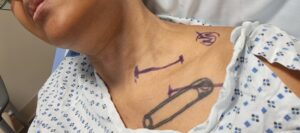
- Late Summer 2026: I undergo 4 venograms in less than a month. The first one results in the placement of a left iliac stent to resolve an almost fully occluded vein. Both upper extremity venograms confirm severe neurogenic and venous thoracic outlet syndrome (TOS) and pectoralis minor syndrome. My only option is a two-part major surgery: a bilateral scalenectomy, pec minor release, decompression of the surrounding areas, and subsequent angioplasty that will hopefully allow me to keep my ribs intact. I also undergo bilateral scalene blocks—the injection of numbing agents and a steroid into the scalene muscle and brachial plexus, mainly so insurance will approve the surgery.
- Fall 2026: I consult with a brain and spine surgeon who specializes in IJVC decompression, and he confirms what I’ve suspected for years: my C1 and styloid have obliterated my jugular veins (as in, they literally vanish on imaging exams); my collateral veins are among the largest he’s ever seen in decades of practice; he has no idea how I’m functional at all; and I need to get on his surgical calendar fast for a major inpatient decompression surgery because he’s booking out to November and I’m not going to make it that long.
I’m supposed to turn 43 in November. It was a strange sentence to hear.
Mine is such an open-and-shut surgical emergency, he skipped the preliminary tests he usually orders for insurance purposes and went straight to requesting surgical precertification. (And of course, as of this writing, I’m still dealing with Aetna’s shenanigans, as they’ve delayed, processed, canceled, stalled, and started processing the precertification request again, delaying scheduling even more.)
Regarding these diagnoses, I feel vindicated, terrified, eerily calm, and incandescent with rage. I don’t want to die. I was already too sick to advocate for my care 3 years ago, and I’m much sicker now. The process of advocating for care—particularly while trying to survive at the most toxic, dysfunctional university I’ve ever worked at—has made me sicker. If anyone had listened to me 3 years ago, I wouldn’t be months from death now, struggling to arrange multiple surgeries, wondering every day if I’ll just die with the finish line in sight. I mean, I could. I really could.
And fall semester is underway, and I’m teaching 3 courses and directing a university-wide program because Pace removed my administrative release time.
For a million reasons, medical leave isn’t an option. Insurance reasons. Salary reasons. The common practice in academia whereby upper administration uses medical leave as a reason to demote you, restructure your position, and make life so untenable it forces disabled people out—which Pace is toxic enough to do with or without the pretense of medical leave, frankly, given how administrative offices and faculty members reward and enable abusers here. I have quantifiable, timestamped medical data that proves my health rapidly worsened due to microaggressions, gaslighting, and other abusive interactions by admin and faculty at Pace University, including: our former dean Tresmaine Grimes and associate dean Rich Schlesinger; NYC-ENG co-chairs Stephanie Hsu and Sid Ray and my less-qualified NYC WEC director counterpart Sarah Blackwood; provost’s office attache Kelley Kreitz; HR personnel Luciana Ziegler, Sia Bundor, and everyone associated with the SAS appeals team, who fundamentally misunderstood then violated the ADA in writing; and Provost Alison Carr-Chellman, who signed off on the ADA violation and is also apparently dead-set on abolishing university-wide tenure (and thus any hope of faculty retention and recruitment, not to mention inviting widespread grade inflation. Make it make sense). My interactions with these people led to dangerously high heart rates, including one episode of atrial fibrillation and at least two episodes of ventricular tachycardia; an increase in the number of medical maintenance visits I required; worsened pain and fatigue and involuntary changes in my neck that compromised my oxygen saturation; and so on. Since I have evidence in the form of medical data and email correspondence that I’ll be including in a formal ADA complaint identifying these people anyway, I feel it’s above the board and in the interest of transparency to name these people here in case I die—or the university causes my death, which is a real possibility all these people have been informed of and have minimized or ignored—before my complaint is filed.
I woke up alive yesterday and today, and I was relieved, and I was disappointed. I hope I wake up tomorrow. I hope I can sleep forever. I hope these surgeries, particularly the IJVC decompression, can be scheduled in a timely fashion. Death has shrugged by me more times than I can count over the course of my life. I hope, if my luck has finally run out and I do suddenly die, that my work did something for you—that I meant something to you.