I often blog about research practices that come up a lot in my classes or one-on-ones with students. Since I teach core writing every semester and have been teaching Pace’s writing in the disciplines (WID) core writing course for several semesters now, a research practice that frequently comes up with my students is preliminary research. This is the term I use when introducing grounded theory research to reframe it as a set of research practices that they’ve probably resorted to before. The idea of wading into research without preconceived notions or a rigidly predefined question might be intimidating, but by the time they enter my classrooms, most of my students have engaged in some kind of loosely defined process of fucking around on Google Scholar to figure something out for their research as a sort of “pre-research” step—aka preliminary research.
I’m going to use this post to showcase how I engage in online preliminary research. I’ve included some screenshots to make it easier to follow the hypothetical project I’m working through.
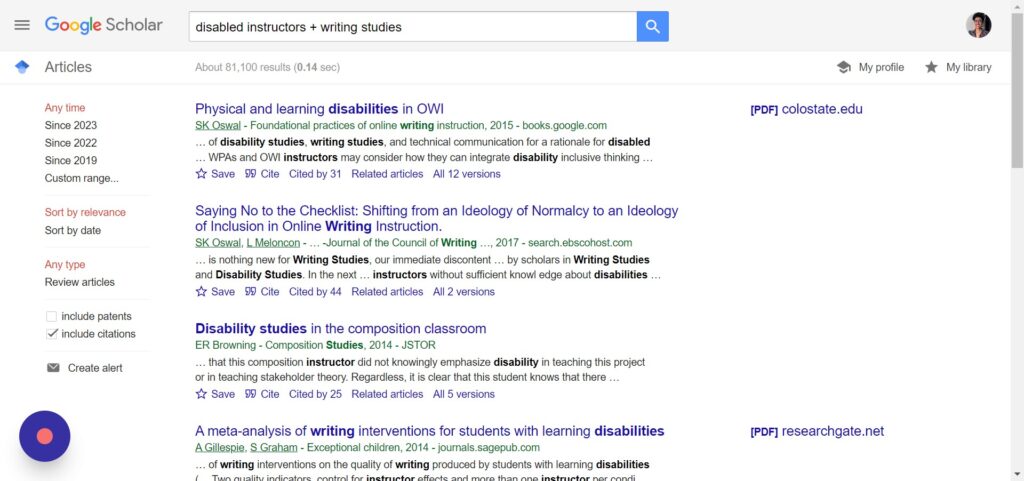
First, I might try a combination of search terms on Google Scholar that broadly speaks to the area I want to investigate. For this particular example, I’ll pick a subject I often wander into—X issues facing disabled instructors in writing studies. However, none of these results really speak to me as a researcher, let alone my experiences as a disabled instructor in writing studies. As you can see, they’re all over the place: students with learning disabilities, rubrics, disability studies, and online writing instruction.
The next logical step is to make my search terms more specific. I’ll start by adding one of my specific diagnoses, “fibromyalgia” (instead of “chronic pain,” which might be too vague):
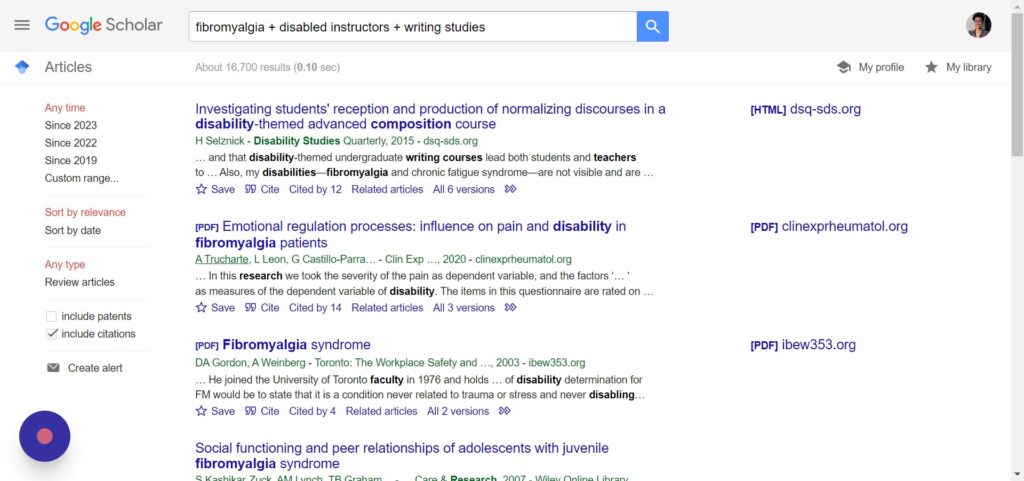
The qualitative research projects I assign in my WID courses focus on the impacts of a contemporary issue on members of a discipline or discourse community; patterning my example after those instructions, these results are more student- than instructor-focused. The problem is likely my use of search string and Boolean operators. I purposely left out quotation marks to make a point: without quotation marks, Google Scholar searches each word independently; once I enclose each phrase within quotation marks, I wrap multiple words into single phrases, which drastically changes the results I get:
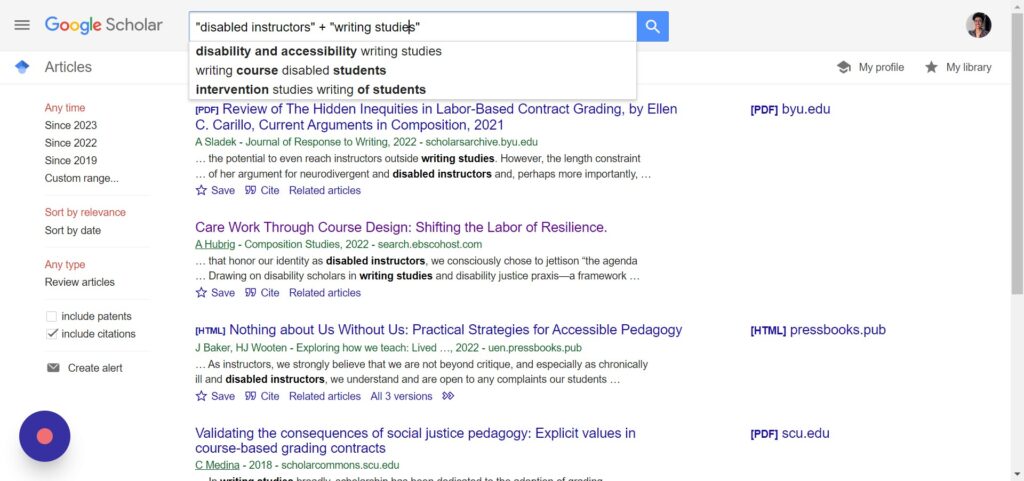
Notice how the addition of quotation marks, transforming single words into phrases, immediately focuses my results on disabled instructors in writing studies. The difficulties of performing care work and implementing accessible pedagogy as chronically ill and disabled instructors is a viable direction for the qualitative research project guidelines
Just to see what changes, I experiment next with moving from a whole field to a specific site, the “writing classroom”:
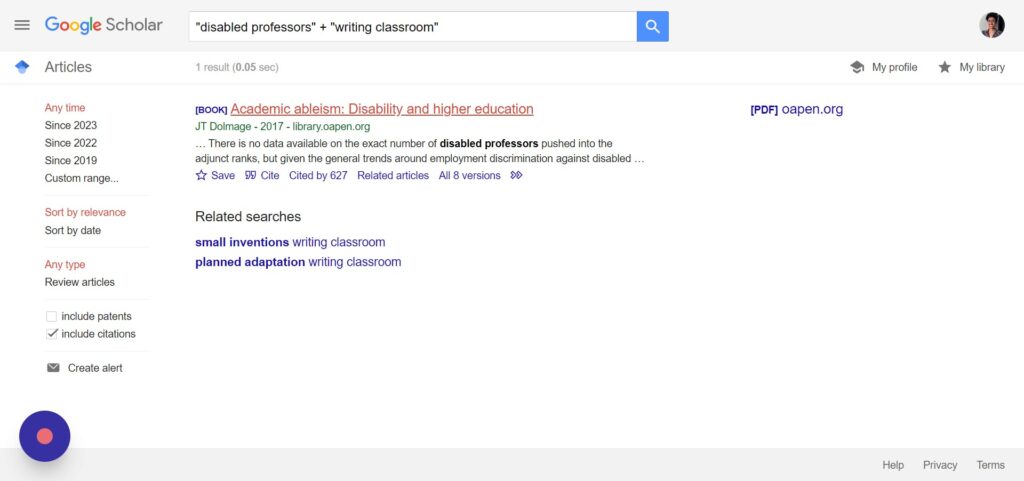
That’s clearly way too specific, as it leaves me with a single result—albeit an excellent one that I’m likely to use!
Next, I use synonyms and substitutions to see what changes:
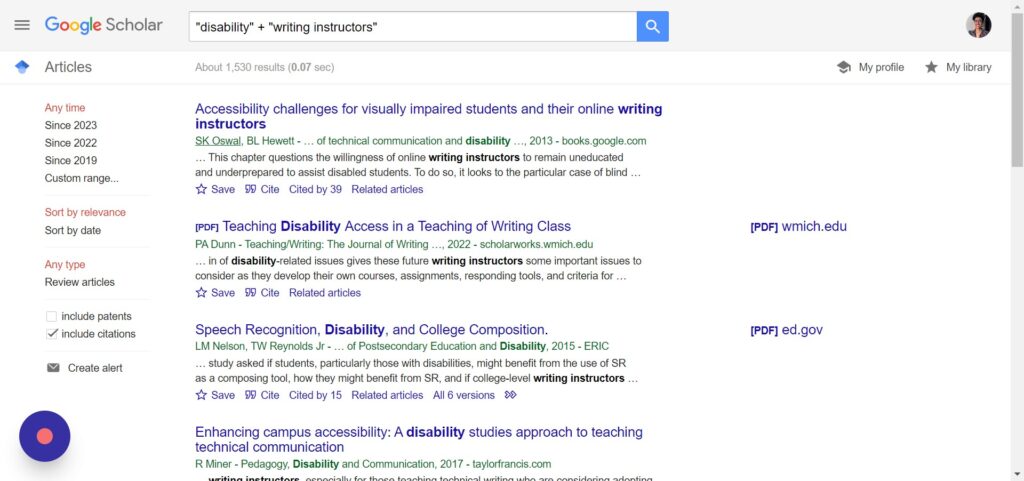
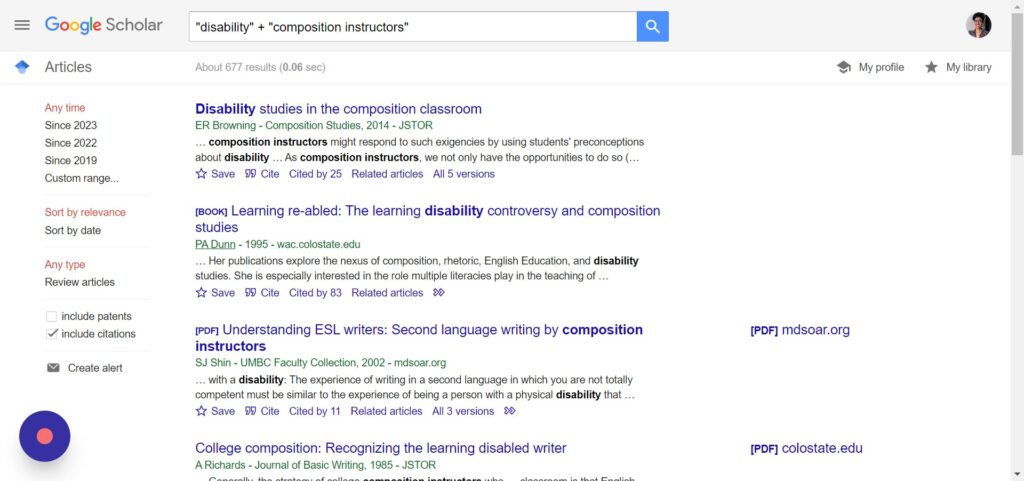
And finally, just to make sure that the issue of access, care, and writing instruction wasn’t just a fluke, I might try adding one of those words in and substituting synonyms to see what changes:
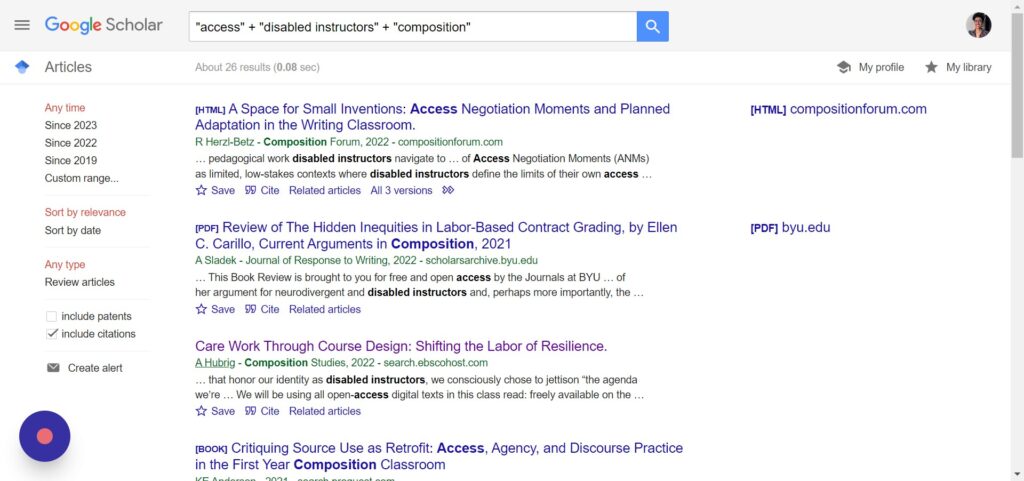
The fact that the Hubrig source reappeared along with new keywords that speak to similar issues of access negotiation and care work in the classroom suggests that this could be the start of a fruitful research project.
Using Dolmage, Hubrig, Brown & Leigh and a few other sources that aren’t pictured, I can get at the nuts and bolts of the Research Introduction: (1) identify a preliminary issue I might want to examine, (2) provide background for it, (3) use it to describe my own interest in the issue as a fibromyalgic writing instructor impacted by the same issue, motivation for entering the field the and form a set of research questions:
Disabled writing instructors, especially those with invisible disabilities, are under-represented in academia due to the risks of disclosure (the possibility of being fired or discriminated against) and a lack of architectural accessibility. Fibromyalgic writing instructors suffer from incurable chronic pain that isn’t always visible, and writing itself is a painful activity even with ergonomic setups. My research questions right now are: How do fibromyalgic instructors negotiate access in the writing classroom through disclosure and accessible pedagogy? How do they use accessible pedagogies to accommodate themselves and their students? What do their strategies tell us about ableism in academia, especially writing studies?
Hopefully showcasing my own approach (even in this reductive way) will help if you’re trying to write an undergraduate qualitative research project like the one I’ve described above and keep getting stuck, or if you’re trying to better understand and attempt grounded theory research.


