I owe a lot to Dr. Raul Pacheco-Vega’s blog posts about academic productivity, especially his specific recommendations about reading and writing and his personal struggles with workaholism and health. I never met him in person, but his social media presence was as familiar and warm as friendship. And it was on social media that I learned of his death.
I think a lot about digital preservation, so I tend to copy websites that I rely on heavily, in case they ever go dark for any reason. I’m grateful for my paranoia, because shortly after he passed, while his Twitter feed is still live, his website isn’t—but I’d already copied it (HTTrack Website Copier ftw).
Given that his website is no longer publicly available, and that I regularly share his reading and writing strategies with my undergraduate students, and that I’ve adapted many of those strategies to suit my specific disabilities and access needs and credit my academic survival in part to that, and that students and colleagues regularly ask me about my disabled approaches to academic reading and writing… I thought one small thing I could do to honor Raul’s life and work would be to (finally) publicly write up my own strategies, including how I’ve used and modified his.
The AIC and CSED methods paraphrased here are Raul Pacheco-Vega’s (RPV from here on, as my students tend to affectionately abbreviate); crip modifications to these strategies are mine. But also, while we should always give credit where credit is due, we should remember the spirit in which these strategies are shared: not for personal advancement, but freely, openly, generously—for the betterment of our individual disciplines and academia as a whole.
RPV uses a three-step method for skimming academic papers that he calls “Abstract-Introduction-Conclusion” (AIC) content extraction. The AIC technique is intended to help you find the most relevant information while reading and, from there, figure out whether or not the article is useful for your current research project—i.e., if you need to close read and annotate it for your current project; if you should save it in a folder of “someday articles” for potential future projects; or if you can discard it entirely.
Almost everyone recommends reading the abstract first (for articles published in academic journals, anyway; academic books are a bit different). However, abstracts are short (250 words max, usually) and can’t relay the most important content in the article. While we should start with abstracts, we shouldn’t trust them to provide us with a rich or fully accurate description of what the paper is about. (You shouldn’t write a rhetorical precis or memo based on just the abstract, for instance!)
The introduction to a paper, though, will usually indicate what the paper is about by the second or third paragraph. I’m presently drowning in an article for a special issue of POROI on the rhetorics of generative AI refusal, so for example, I’ve marked where the introductory paragraphs of a paper on ChatGPT as a bullshit machine provide both context and exigence (i.e., the circumstances that prompted writing the article in the first place) for the paper.
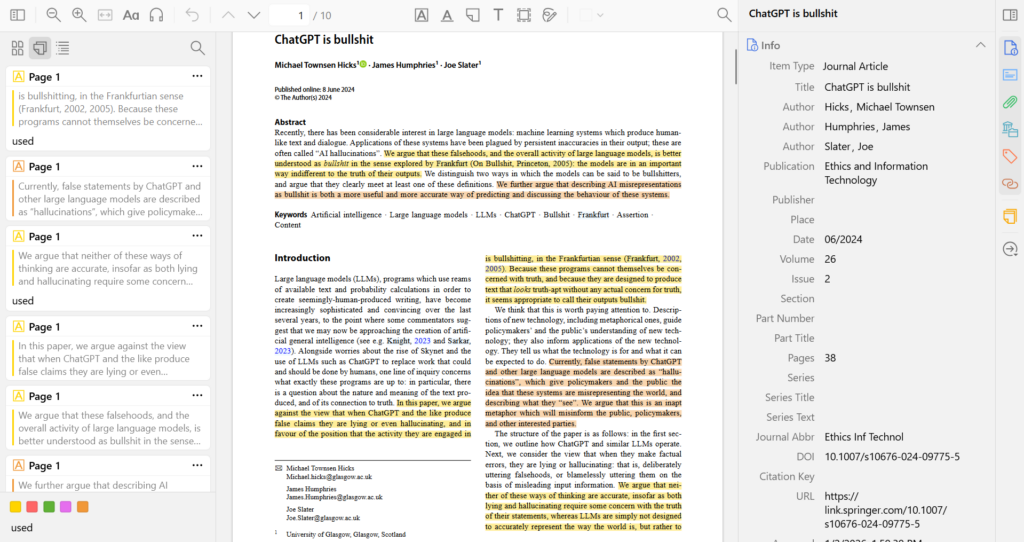
The abstract is an extremely concise summary of information that’s expanded on in the introduction, flagged by signposts like “in this paper” or “we argue” in the first 3 paragraphs. The first paragraph provides context as well as what the paper is about, while the second paragraph provides the exigence for the paper and the third offers an overview of the paper’s structure.
To me, the introduction is the most important part of the paper, since that’s where I expect to see the setup for the entire article: research aims, exigence, gaps in the literature, and disciplinary contribution.
RPV suggests writing down 3 explanatory elements in the paper based on information provided in the introductory paragraphs. As a humanities-oriented interdisciplinary researcher, I’ve modified these elements a bit, though the core concept remains the same:
- What is the author’s primary aim or critical intervention, and what specific phenomenon or case study is being used to illustrate that aim—i.e., the “what”
- How does the phenomenon or case study illustrate that aim—i.e., the “how”
- What is the context and exigence of this research, or why is the author doing it and what gaps in the literature are being addressed—i.e., the “so what” that explains what the article will tackle and why the author (and readers) should care
Depending on the discipline, some introductions will also provide a detailed description of methodology, participants, data collection and interpretation, and so on in their introduction, which might be useful to note as well.
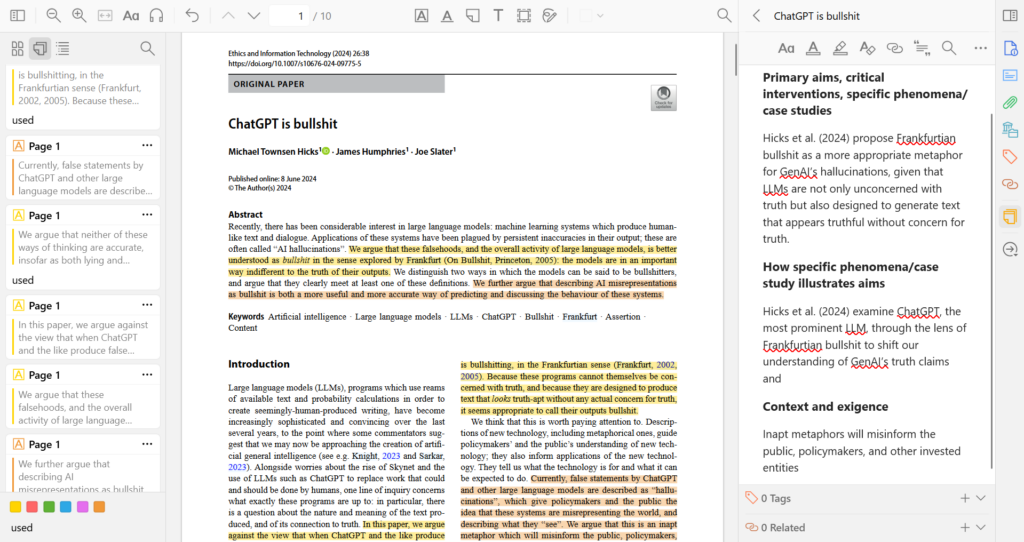
I’m still fine-tuning my move from Citavi to Zotero, so what I’ve been doing—instead of using an Excel sheet or Word document to manage my answers to these questions—is writing notes attached to the source in Zotero itself. (I tried using Obsidian for all these notes, but I vastly prefer having everything in one platform, ideally attached to the actual PDF or hard copy citation of the source in question).
As part of how I process research articles, I add two notes titled “AIC” and “CSD” right away. I’m a little embarrassed by my first-pass reading notes, but here’s what my AIC note currently looks like for “ChatGPT is Bullshit”:
RPV (and many other researchers) use Excel to manage literature reviews. RPV calls it a Conceptual Synthesis Excel Dump, where the Excel spreadsheet is meant to help you correlate information across columns and rows. This probably makes sense for a lot of people, but my brain needs consolidated notes more than relationships across notes.
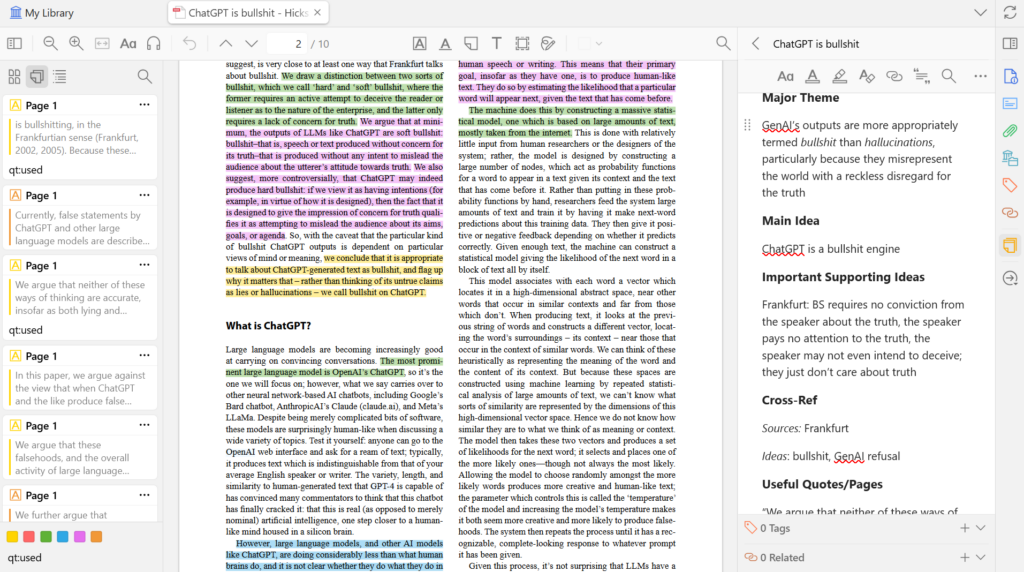
I’ve adapted RPV’s method in Zotero into just a Conceptual Synthesis Dump, using his column headings as headings and subheadings in a note associated with the article in question, which eliminates the need for an Excel spreadsheet altogether. This lets me view all my notes on the article at once and also allows me to search all notes across my Zotero library if I remember some idea, sentence, or scrap of language through brain fog but not the article’s bibliographic information.
For me, retrievability is often more important than relationships across ideas, which I can put together once I’ve rediscovered and am reviewing the notes again. For this reason, my note-taking process is both sparing and extremely information-dense. I spend more time directly annotating the article directly than I do creating and adding to my freeform CSD notes. Retrieval of information within articles as well as across my whole library.
In my own doctoral program, I often wished I had more models of disabled approaches to engaging in the research process, because while I instinctively knew what worked for me, I also often felt like I was just fumbling my way through reading and note-taking, trial-and-error, without a real sense of direction. Hopefully my ramblings here help someone else figure out an individualized crip research process that works for them, AICCSD or otherwise.