You Can't Acknowledge Land without Acknowledging #LandBack.
If you use or modify this statement, please credit Dr. Vyshali Manivannan, Dept. of Writing and Cultural Studies, Pace University – Pleasantville (CC BY-NC-SA 4.0).
CMarie Fuhrman writes in “A poem to acknowledge that the land itself — along with the people whose language, culture and religion were born of it — is rarely acknowledged“:
“We should take another moment to acknowledge the ways Indigenous people have been/are being removed and erased from the land they’ve stewarded for over 16,000 years: Swiftly. Brutally. Culturally. Fatally […] that the land itself is rarely acknowledged […] Let us recognize Land Acknowledgments that serve as consolation, another box checked on a list titled Due Diligences […] acknowledgment as performative allyship […] Land Back means languages back, means medicine back, means ceremony back, means culture back, means reparations. Means all people depend on the land. Let us acknowledge that unless action is taken to identify and empower Indigenous peoples, erase inaccurate history from every school curriculum, carry out land-based justice and climate change policy, a Land Acknowledgment is a perfunctory, alienating, and an otherwise hollow gesture. Acknowledgment means acceptance, admittance; acknowledgment is a dead word, is not a verb, is not deed, does not mean education. Acknowledgment means too late for an apology.”

This is what land acknowledgments often feel like: never enough in isolation but too often presented alone, and further impoverished by their superficial, performative delivery and reception when the real mission statement behind them is one of truth, reconciliation, and reparation. Now commonplace in the U.S. to the point of triviality, they’re polite, sanitized for settlers, passive. How many land acknowledgments have you heard that acknowledged the land itself and its injuries, that told their own stories rather than the stories most palatable for people who are not Indigenous, who do not know what it is to be a murderer’s joyful tally mark, to be forcibly estranged from your ancestral homelands even while you still occupy them? It is rare enough to hear code-meshing that makes a good-faith attempt at correct pronunciation, never mind directions to donate money, labor, time, and/or instruction or a cessation of activity to carry them out.
If land acknowledgments have the potential to begin to dispel America’s origin myth and revise the audience’s relationships with the stolen lands on which they reside while honoring the original stewards of that land, the central problematic of land acknowledgments must be recognized: After all these years of making them, what’s left to acknowledge but what the listener is or isn’t willing to give?
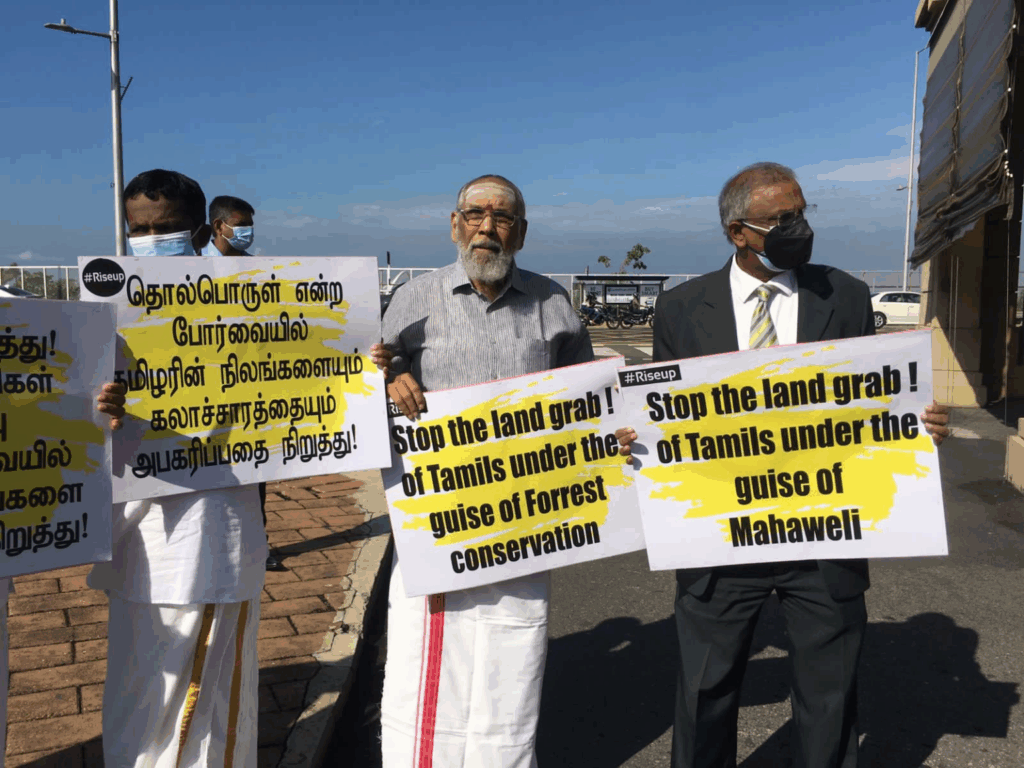
I know the unceded territories known as New York, where I live and work, are the custodial lands of the Lenni-Lenape people, and all the other Indigenous peoples who have been or become part of this region. My own positionality as a member of the Eelam Tamil diaspora, born and raised on stolen land in the U.S.—a nation founded upon genocidal settler colonization and land theft whose legitimacy requires the erasure of its systematic violence—means genocidal violence prevented my parents from returning home. In Sri Lanka, over a decade after the end of the armed conflict, Tamils in the North and East (Eelam) and abroad are still struggling to reclaim their land from military occupation. Under the guise of national security and as part of an overt Sinhalization effort, the government has internally displaced Eelam Tamils and occupied their lands, including ancestral homes, businesses, memorials, religious sites, and LTTE cemeteries, using them for agricultural purposes or commercial profit. As an Eelam Tamil American who often writes about the Tamil genocide, I strive to cite and engage with Eelam Tamil knowledge, amplify Eelam Tamil histories, and support Eelam Tamil people in the North-East of Sri Lanka through Tamil-led organizations like People for Equality and Relief in Lanka (PEARL).
This work exists in alignment with the struggle for Indigenous rights in the U.S. I am grateful to Indigenous people for standing in solidarity with Eelam Tamils in the diaspora, and I am honored to stand with them when and as I can. As a disabled scholar, I lack the capacity for visible, performative activism, but this doesn’t mean material action is beyond my reach. On- and off-line as my bodymind permits, I engage in public writing, share resources created by Indigenous collectives, promote and teach work by Native authors, donate money to Indigenous-led organizations, support Indigenous-led grassroots campaigns for environmental protection, the removal of tributes to colonial war criminals, and the return of stolen property, like ceremonial objects and land. I refuse extractive technologies like generative artificial intelligence (GenAI) that accelerate the disappearance of disappearing people and languages, that insistently center whiteness and settler colonialism, that damage lands already damaged by industrialization, pollution, harmful agricultural practices, the uses and abuses of settler colonialism.
Indigenous land will always be Indigenous land. Eelam will always be Eelam. Our fights are complementary and intertwined.
This land acknowledgment would not be a land acknowledgment without abandoning the genre entirely to ask you:
- How do you sustainably contribute to Indigenous rights, including the return of land, for Native Americans, and Indigenous people disenfranchised from their ancestral homelands elsewhere?
- Do you understand return as a transactional relationship that cannot abide multiple peoples coexisting?
- How do you consistently bring others into the movement, without decentering or distracting from Indigenous desires, needs, and people?
- If you use GenAI technologies, how does your land acknowledgment acknowledge the hypocrisy of using GenAI despite its climate impacts while claiming to honor Indigenous concerns?
- And if you pretend the COVID-19 pandemic has ended and no longer mask, how does your land acknowledgment acknowledge the hypocrisy of honoring Indigenous people while ignoring how an arm of colonizers’ ethnic cleansing was the unchecked spread of deadly disease, while ignoring the fact that COVID-19 disproportionately impacts marginalized communities?
If any of those questions give you pause: Stop acknowledging. Start listening, reflecting, practicing. Maybe then you can write a land acknowledgment that will reflect your personal relationships with the land and your responsibility to it, along with your personal, intentional, ongoing commitment to the work you have been doing in solidarity and what you must continue to do.